(by: Logan Rietz)
It’s happened to everyone at some point. You’re warming up with your opponent and you notice one of three things:
- They hit a ball and it just sounds funny
- You can’t seem to time the ball correctly
- When you switched to warming up backhands, they twiddled for some reason
You stop warming up and ask to see their paddle, but you already know. They’re playing with pips. Now all the questions start running through your head….How good are they with the pips? Are they short or long? Do they chop back from the table? Chop block close to the table? Do they hit with them? Do they have sponge? Do I have to worry about them twiddling with them mid-point? How do I serve now? No matter what, you’re going to have to pay more attention than you would against a regular inverted player.
So where do you start?
First, you need to know what pips do and don’t do compared to inverted rubber. There is lots of misinformation and confusion out there, so let’s set a few things straight. To make this a little easier, we are going to use Tenergy 05 as our comparison rubber, as it is a well-known quantity, and a significant number of players know how it performs.
Pips Generate Less Spin
Due to the amount of grip potential with pips out rubbers, you can’t generate near the same amount of spin as you can with inverted rubber, but what does that actually mean? It means you’ll have to keep several things in mind if you want to come out on top. In no particular order:
- You need to keep your blade angle more open and hit the back of the ball
- The ball will travel on a flatter trajectory and will have less dip to it
- Since pips can’t generate as much spin, they also are less susceptible to incoming spin
- The more sponge it has, the more it will play like inverted
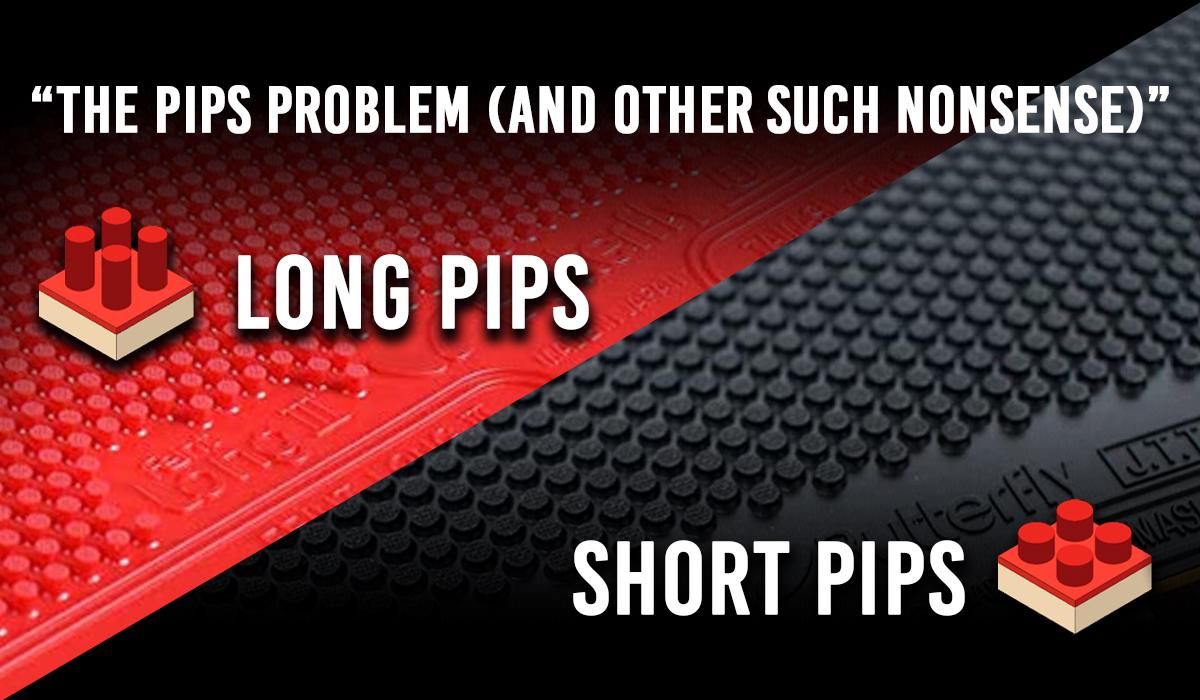
Long Pips
Long Pips are predictable (except when they aren’t). There are lots of factors that affect how long pips react to incoming spin including sponge thickness, sponge density, pip aspect ratio, blade hardness, and more. Inversely, all of these also affect balls hit with long pips. For ease of explanation, let’s compare Feint Long III, both in OX (no sponge) and 1.3 mm sponge. With Feint Long III OX, it is incredibly difficult to flip the spin. For example, if your opponent pushes a ball to you with underspin and you push back with the OX pips, it will return with light topspin instead of the underspin an inverted would create. However, the same pips with 1.3 mm sponge will be able to generate some underspin of its own, just not as much as inverted. With this amount of variation possible with the same pips, one can see how it would be difficult to know what to expect with so many different pips available and different sponge options to boot.
Long pip variability is great as the aspect ratio (pimple height/pimple diameter) can differ, there are bigger differences in sponge options, flexibility of the pips themselves can drastically affect the ball, and so on. If you want to focus on playing back from the table and chopping, Feint Long III, Ilius S and Feint OX would all do the trick, though each offer different levels of stability. Any players that want to stay close to the table and have more consistent attacking abilities in addition to defense should look at Feint Soft, Feint Long II, and Ilius B. Feint AG is the most aggressive long pip rubber Butterfly makes and is great for attacking players that like to stay close to the table.
Short Pips
Players looking for traditional short pips should consider either Challenger Attack or Speedy P.O. Both of these have medium sponge densities and flatter ball trajectories. They are also slower with less spin potential. Though these last two factors sound like potentially negative attributes, they present different looks than most opponents are used to, as they are bigger detractions from standard inverted rubber. For those who want a faster, slightly spinnier option, Impartial XB is a great fit. It is a balanced allround rubber, performing well blocking passively as well as attacking with speed. Attack-minded players would be well-suited to play with Impartial XS, as it has blistering speed and tons of spin for a pip rubber. It would also be the easiest to transition to from inverted rubber.
Anti
The outlier of outliers is Anti-spin rubber and it is even more of an outcast, with even fewer players using it. Essentially, anti-spin reacts exactly as the name suggests; it generates VERY little spin and all but nullifies the incoming spin. As with long pips rubber, it is best utilized in conjunction with a fast, spinny rubber on the other side of the paddle. Players that are able to stay close to the table with very good touch can give players fits with their ability to change the speed and depth of their blocks, making their opponents generate all their own power and spin. Throw in a good twiddle and now your opponent will really be reeling! Super Anti is a great option for those that seek to disturb the normal game flow close to the table. Just ask 5-time National Champion and former World #19 Danny Seemiller.
Okay, sooooooo, now what?! Don’t shy away from pips or anti, either playing against them or using them yourself! The best way to understand what to do with them and how to play against them is to get all the experience you can with them. Have an old blade sitting around? Throw some funky rubber on there and see what you can do with it! Make your practice partner use it for a while so you get more experience hitting against it, too. Especially pay attention to how it blocks, hits, chops, and receives serves.
Stay “In The Loop” with Butterfly professional table tennis equipment, table tennis news, table tennis technology, tournament results, and We Are Butterfly players, coaches, clubs and more.